
FILM × CRITIC
DIRECT REVIEW / ESSAYTHE GODFATHER × PAULINE KAEL
Where does power’s beauty place the spectator?
Beginning with Pauline Kael’s contemporary review, an EYE/ERROR reading of family, allegiance, and the politics of access.
Original sourcesPauline Kael: Alchemy, The New Yorker (1972)AFI Catalog: The Godfather, credits and synopsis
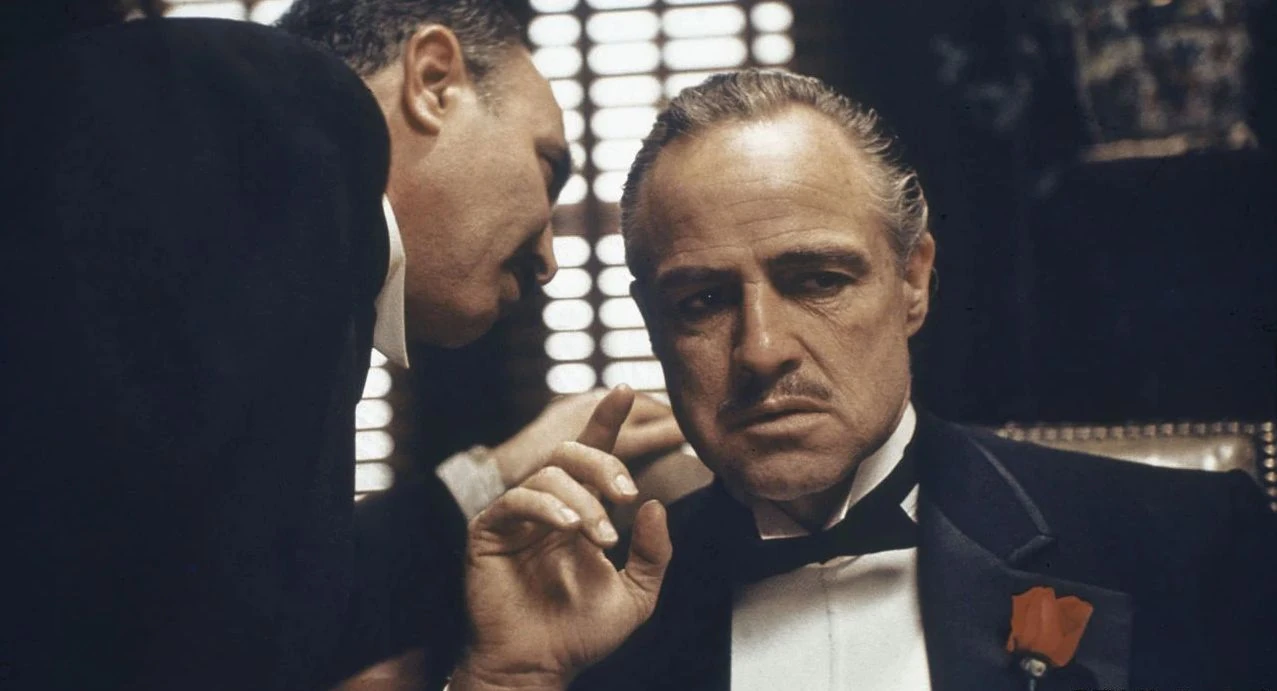
Does fascination with a criminal family amount to consent to its crimes? The Godfather makes those responses difficult to separate. In Francis Ford Coppola’s 1972 film, familial warmth, business discipline, and violent authority shelter one another. The familiar pleasure of belonging brings the spectator close to a system whose security depends on somebody else’s insecurity. Its moral difficulty exceeds the question of what a character does. It also involves the company we find reassuring, and the kind of protection we become willing to accept.
In her contemporary review, ‘Alchemy,’ Pauline Kael celebrated Coppola’s transformation of popular material into art. Taking that judgment as a starting point, this EYE/ERROR reading asks what aesthetic attraction does politically. Fascination can become evidence for criticism. Once a voice, face, or room feels trustworthy, how does that confidence organize our subsequent judgments? This is our interpretive question, rather than a claim that Kael supplies a finished theory of spectatorship. A rigorous response can preserve the pleasure while examining the allegiances that pleasure produces.
The opening wedding and private audiences, documented in the American Film Institute’s catalogue, connect celebration with patronage. To a petitioner, power can initially appear as a service. Gratitude, remembered obligations, and future claims gradually make that service a debt. On this reading, the family is more than a respectable cover for criminal activity. It gives abstract domination a recognizable face and a persuasive emotional vocabulary. Protection becomes intimate enough to feel humane, while its selective distribution establishes who may depend on whom and on what terms.
Reading Michael’s trajectory solely as an innocent man’s corruption can obscure the reproduction of an institution. Disliking a system is different from escaping its benefits, inheritance, and emergency justifications. Once a family crisis speaks in the language of personal responsibility, assuming power can look like sacrifice. EYE/ERROR’s emphasis falls on that self-description: people can become effective administrators of injustice without announcing themselves as villains. Decisions that remain intelligible to the decision-maker can steadily narrow everybody else’s room to act, question, or refuse.
The closing door, also recorded in the AFI account, does more than symbolize secrecy. It distributes membership: who belongs inside, who may witness a discussion, and which version of events reaches an intimate partner. Spectators can acquire privileged knowledge through closeness to a character without sharing that character’s rights. The difference between knowing an institution’s secrets and being recognized by it gives the ending its relational force. Authority survives through everyday permissions as well as spectacular violence. A domestic threshold can perform the work of a political boundary.
For a young filmmaker, the useful exercise reaches beyond imitating a celebrated lighting style. Examine whether the sympathy you build for one character makes another person’s experience disappear. List the relationships, information, and emotions that make an apparently necessary decision feel necessary; then imagine the same event from outside that arrangement. Such an exercise treats form as an allocation of attention and trust. Taking The Godfather’s beauty seriously means accepting responsibility for the position from which that beauty invites us to judge, including the people whose position it makes harder to occupy.
Read the original sources
GO DEEPER