
CRITIC’S METHOD
WHOSE EYES ARE THESE?
LAURA MULVEY
Original sourcesLaura Mulvey, Visual Pleasure and Narrative Cinema, Screen 16.3 (1975), 6–18: original journal recordLaura Mulvey: British Academy research profile
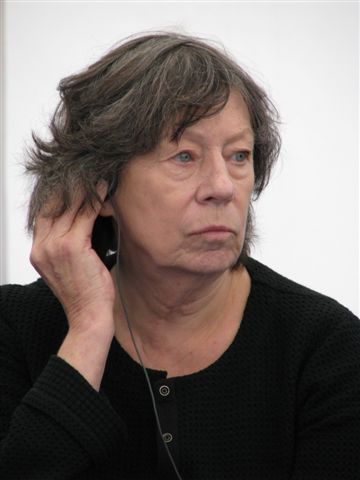
A film can give one character the power to look while arranging another as the object of that look. Laura Mulvey’s Visual Pleasure and Narrative Cinema, published in Screen in 1975, uses psychoanalytic theory to investigate how patriarchal structures organise pleasure in dominant narrative cinema. The essay is a historically situated theoretical intervention. Its account of looking should not be reduced to the claim that every male viewer responds identically or that every image of a woman produces one fixed effect. Its force lies in examining the organisation that makes certain relations of agency feel natural.
For an EYE/ERROR viewing exercise, distinguish the camera’s presentation, a character’s look and the position offered to the spectator. They may align, pull apart or change during a sequence. Who first notices the person entering a room? Does a cut give us that character’s view? Does the scene suspend narrative movement to display a body? What happens when the person being watched looks back? These questions require attention to editing, performance, framing and sound together. The presence of an attractive body alone tells us little about the full structure of the scene.
The distribution of knowledge is equally important. A figure may occupy much of the screen while knowing little and deciding nothing. Another may remain visually absent yet control the scene’s direction. Trace who initiates an action, whose uncertainty matters and whose experience receives a reaction shot. Then ask which pleasures the film attaches to that arrangement. This procedure is our practical use of Mulvey’s intervention, rather than a claim that her essay provides a complete account of all spectators. Historical context and differences of race, sexuality and viewing situation demand further investigation, including the challenges developed by bell hooks.
For a filmmaker, changing the gender of a role may leave the underlying visual arrangement intact. Try redistributing the scene’s knowledge, duration and capacity to act. Give the watched figure an activity that does not exist solely for the watcher, and examine how the scene changes. For a critic, describe the specific mechanism before assigning the label of a gaze. The value of the concept is its ability to expose an organised relationship between pleasure and power. Used without evidence, the label can become as automatic as the conventions it was designed to question.