
FILM × CRITIC
DIRECT REVIEW / ESSAYTOKYO STORY × ROGER EBERT
Who has time available for care?
From Roger Ebert’s humane response to a reading of time, family obligation, and the limits of sympathy in Ozu.
Original sourcesRoger Ebert: Tokyo Story, Ebertfest reprintDavid Bordwell: Tokyo Story: Compassionate Detachment (2013)
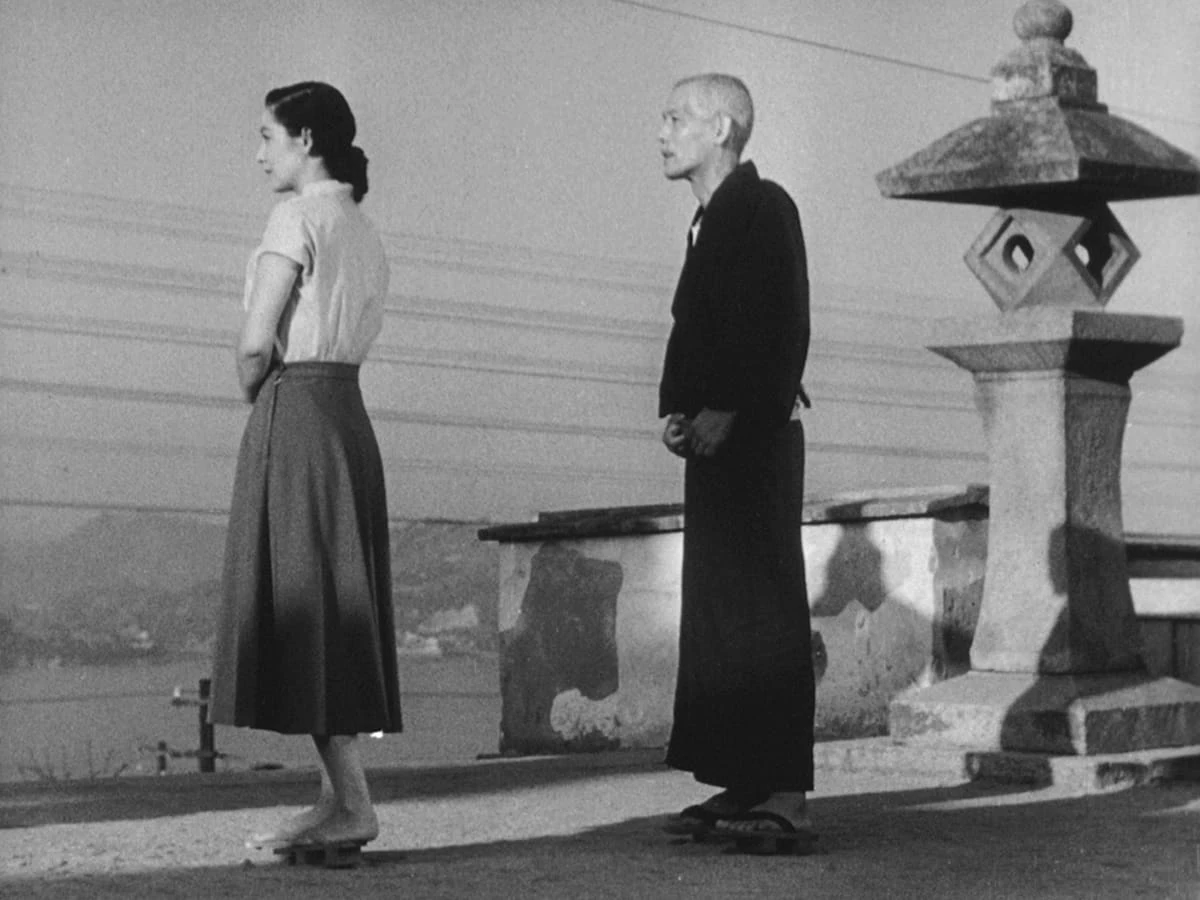
A family visit is an ordinary journey. When somebody cannot make the return journey, earlier busyness acquires a different meaning. In Yasujiro Ozu’s Tokyo Story, released in 1953, an elderly couple visit their adult children; the visit strains everyday arrangements, and the mother’s subsequent death brings the family together again. That modest outline opens a difficult account of care. Claiming to love someone and surrendering time for them are different realities. The sincerity of the first does not automatically compensate for the absence of the second.
Roger Ebert emphasizes the film’s restraint in producing emotion and the painful recognition of familiar family failures. EYE/ERROR takes that recognition as a beginning rather than a guarantee of understanding. A spectator identifying with a neglected parent may also occupy the position of an impatient child. The film’s ethical usefulness lies partly in enduring that uncomfortable change of seats. Recognizing ourselves can enlarge attention, but it can also turn unfamiliar lives into reassuring versions of our own. Sympathy remains something to examine as well as something to feel.
David Bordwell’s account supplies further attention to the family’s organization and Ozu’s narrative construction. Alongside it, our question concerns the distribution of time. Work, housing, distance, and habit establish practical conditions for care; personal goodwill is only one part of those conditions. Showing that a character is busy need not excuse every choice that character makes. Condemning a failed encounter as proof of total cruelty can equally conceal the pressures through which neglect becomes ordinary. An explanation of circumstances and an acknowledgment of responsibility can belong to the same critical account.
A quiet register should therefore not be confused with passivity. Even without open accusation, expectations, embarrassment, and disappointment change a relationship. Politeness may postpone a confrontation, while leaving its cost with the person least able to insist. In EYE/ERROR’s interpretation, restraint places additional responsibility on viewers because a feeling does not arrive with its definitive label attached. We must infer, then resist treating the inference as ownership of another person’s interior life. Silence is an unreliable certificate of agreement, contentment, or the absence of injury.
Death makes earlier time irreversible. Understanding acquired afterwards cannot lengthen the visit that has already ended. This asymmetry keeps the film from becoming a simple moral instruction: remorse can be sincere without replacing care that was withheld. Noriko’s position also complicates an equation between biological kinship and practical obligation. Family membership, the attention actually offered, and the right to choose a future life require separate consideration. Keeping those claims distinct lets the characters remain interdependent people, rather than examples arranged to prove that one generation is good and another bad.
As a filmmaking exercise, write a family visit and examine each pause and departure. Whose conversation is allowed to continue? Who cannot finish speaking? Whose departure reduces somebody else’s work? These specific relations are more useful than declaring slowness a virtue under Ozu’s name. A decision about duration matters through what it lets us understand about people. A film about care may make an audience cry; a harder achievement is to make the audience’s own habits of allocating time appear strange, contingent, and available for reconsideration.
Read the original sources
GO DEEPER