
FILM × CRITIC
DIRECT REVIEW / ESSAYPERSONA × SUSAN SONTAG
When does silence become power over another person?
From Susan Sontag’s contemporary reading to questions of language, intimacy, and the right to interpret another face.
Original sourcesSusan Sontag: Persona, Sight and Sound (1967); BFI edited reprintIngmar Bergman Foundation: Persona, production record
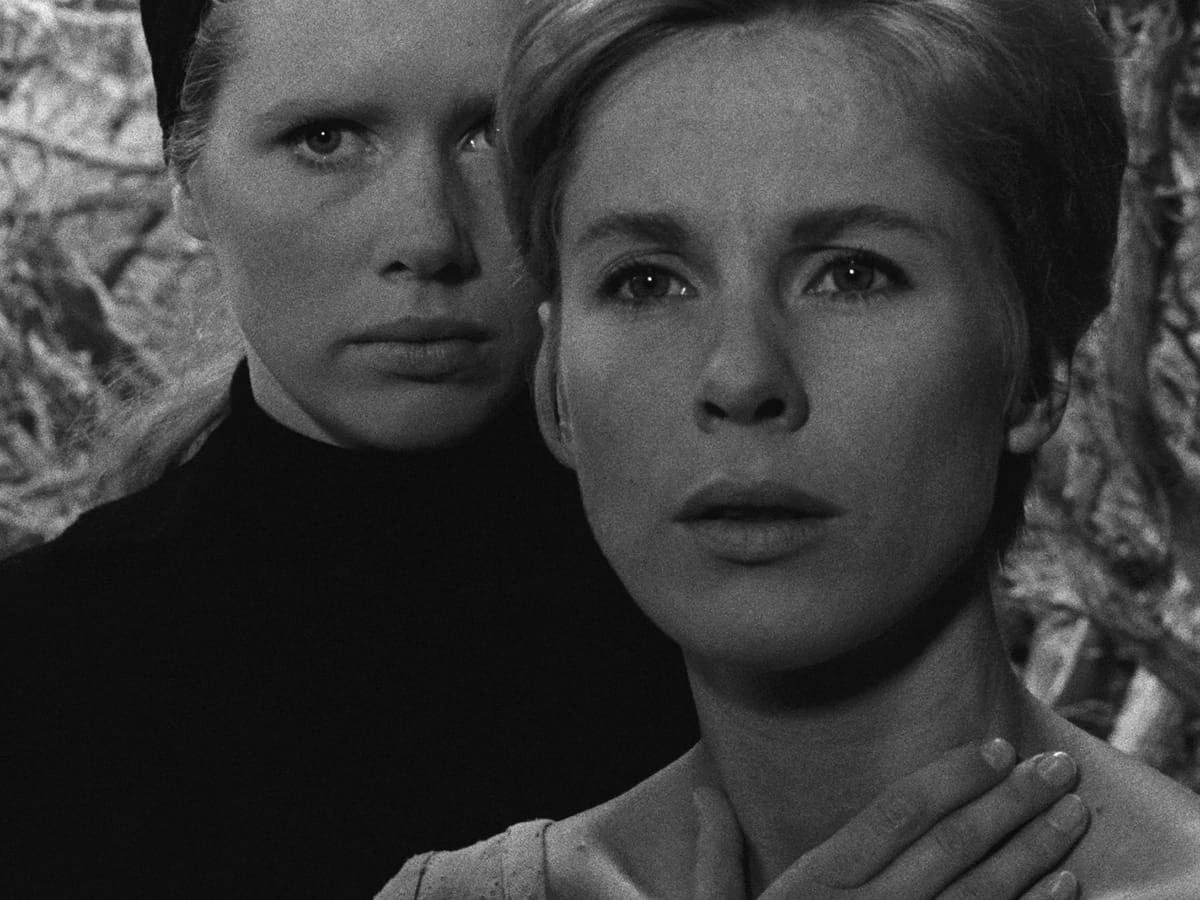
Someone who stops speaking does not thereby leave a relationship. If the other person must keep explaining herself, silence can become an active force within the encounter. In Ingmar Bergman’s Persona, released in 1966, actress Elisabet’s withdrawal from speech and nurse Alma’s talk create a field for examining that imbalance. The film makes it difficult to treat a face as a transparent window onto an interior truth. Looking closely and looking for a long time do not make us the reliable owners of another person’s feelings. Intimacy and complete knowledge remain distinct.
Susan Sontag’s 1967 review attends to language, its failures, and the unequal exchanges between the women. The BFI’s edited programme-note reprint provides our primary critical reference. EYE/ERROR develops a related question about the power of the listener. Attentive listening may express generosity; it may also collect somebody else’s disclosures while protecting the listener from equivalent exposure. That extension is our reading, rather than a claim to reproduce Sontag’s whole argument. The same outward behaviour can acquire a different ethical meaning when the conditions of reciprocity change.
Confession therefore has a complicated relation to truth. Even a candid account depends on whom it addresses, what response it hopes for, and which risks the speaker assumes. The absence of a reply can pressure someone into supplying further explanation. More disclosure increases intimacy without guaranteeing equality. In this interpretation, speaking about private experience should not automatically count as liberation. What happens to the information afterwards also matters. A person can describe herself accurately and still lose control of the circumstances in which her account will be circulated or interpreted.
Facial resemblance and unstable identity can tempt viewers to announce a single hidden key. The Ingmar Bergman Foundation’s production account does not establish the idea of the women as one person as the film’s exclusive answer. EYE/ERROR likewise keeps it available as an interpretation. A film can disturb our categories without furnishing a secret dictionary that settles every event. Accepting uncertainty does not mean that all explanations become equally persuasive. We can still ask which relationships an account clarifies, which evidence it overlooks, and what it must invent to remain coherent.
There is also an ethical risk in filming a face. A spectator may feel that close visibility entitles them to total access, as though the person has become fully exposed without the power to refuse interpretation. Visibility does not establish interior transparency. Attempting to read a feeling differs from fixing a person’s meaning for them. This reading of Persona places that limit alongside formal analysis: what information does a face offer, how much do we demand, and where do we imagine our entitlement to that additional knowledge begins? The demand itself deserves examination.
Filmmakers can annotate a conversation with the response each statement expects. When that response fails to arrive, how do posture, the amount disclosed, and confidence change? Instead of simply removing dialogue to manufacture mystery, specify the redistribution of power. This exercise does not recommend reproducing Persona’s story. It puts an insight about speech, listening, and visibility to practical use. Every formal decision helps constitute a relationship between people and also between a film and its audience. Awareness of the limits of seeing can sharpen a film more than the satisfaction of having finally explained somebody away.
Read the original sources
GO DEEPER