
FILM × CRITIC
DIRECT REVIEW / ESSAYJEANNE DIELMAN × LAURA MULVEY
Who gets to call domestic time insignificant?
Starting from Laura Mulvey’s essay, a reading of labour, routine, and the political conditions of attention in Chantal Akerman.
Original sourcesLaura Mulvey: The greatest film of all time (2022)Criterion film record: Jeanne Dielman (1975)
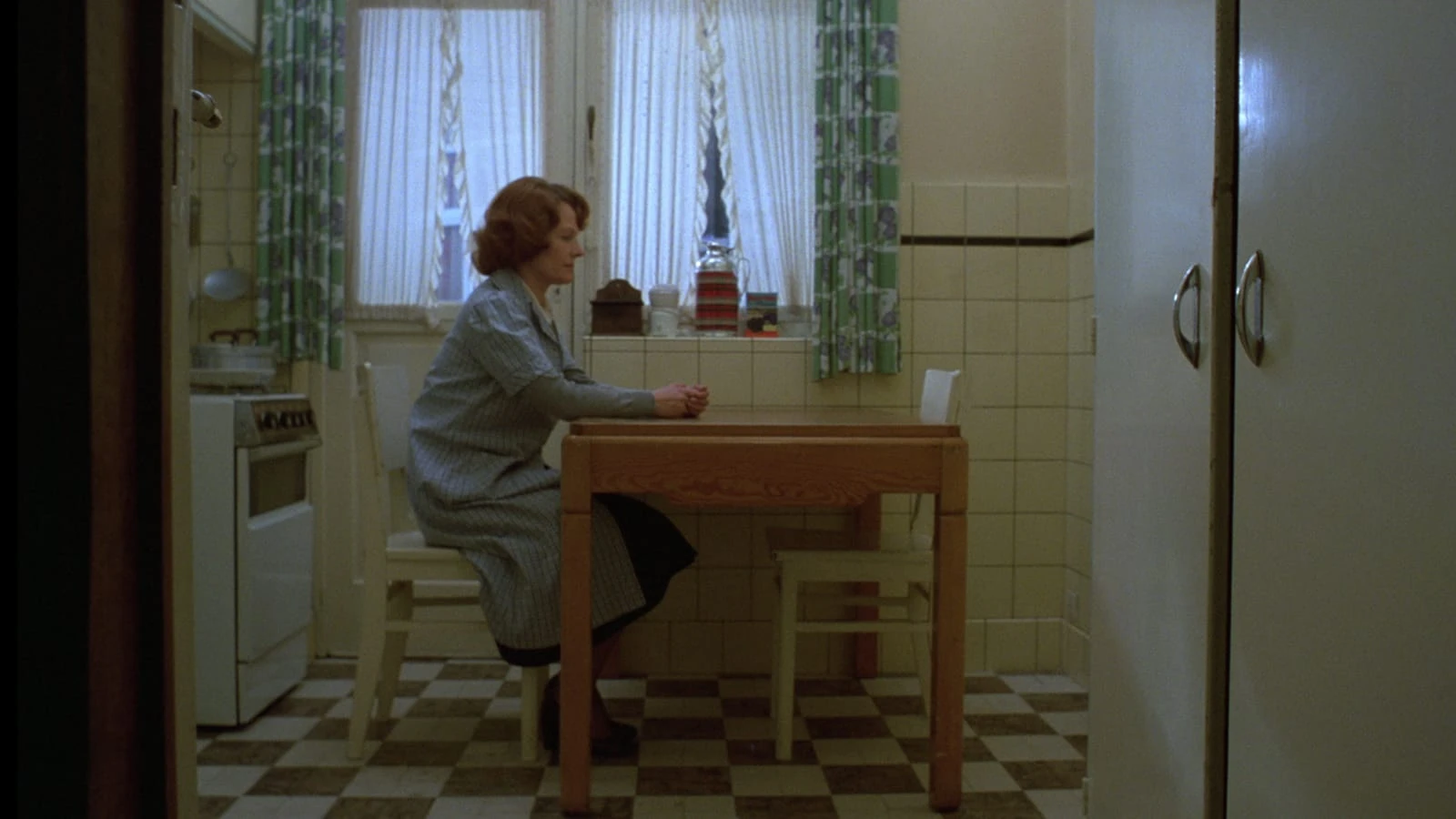
A home remains habitable each day through work that can disappear precisely because it succeeds. Cooking, cleaning, and organization seem not to have happened when everything is ready on time. Chantal Akerman’s Jeanne Dielman, released in 1975, interferes with that disappearance. Attending to the daily life of a widowed mother who also undertakes sex work, the film prevents labour from becoming merely the interval between more important events. Spectators receive more than information about work: their expectations encounter the time that work requires.
In her 2022 essay, Laura Mulvey addresses the film’s feminist significance and the relation between its rigorous form and the character’s fragile attachment to routine. Taking that connection further, EYE/ERROR asks how spectators learn impatience. Which activities do we want completed quickly? Which seem sufficient subjects for a scene? Those judgments are socially formed. The more conveniently somebody’s labour supports another person’s life, the easier it can become to overlook. Habits of deciding what deserves cinematic importance can reproduce that imbalance of attention.
Giving time weight does not mean claiming that everything is presented continuously in real time. Selection, omission, and patterned recurrence construct the film’s duration. The distinction matters: treating a long scene as automatic proof of reality erases the filmmaker’s decisions. In this reading, an activity matters because the film makes its continuity, interruption, and variation perceptible, rather than because sheer length certifies its value. Reorganizing attention is an aesthetic intervention into social valuation. Duration becomes useful through the relationships we can understand within it, not through a rule that longer must mean truer.
Reading routine solely as repression would also diminish the contradictions of a life. A daily system can provide income, care for a child, and a means of maintaining a position in the world. The same system can leave little room for uncertainty or desire. To assess a disturbance, we first need to understand the relationships among activities that have come to seem normal. This interpretation is not a clinical diagnosis. Neither a character’s habits nor a viewer’s discomfort supplies a complete medical explanation of that character’s interior state.
Considering sex work and household work within one person’s schedule puts pressure on easy moral classifications. Which labour earns money, which becomes a supposedly natural family duty, and which incurs social stigma? Those divisions converge upon a body and its available time. EYE/ERROR examines the relationship without declaring all working conditions identical. Similarly, calling the ending a straightforward emblem of liberation would resolve its violence and uncertainty in advance. A feminist reading can insist on structural inequality while remaining responsible to the disturbing particulars that resist a reassuring political conclusion.
A useful exercise for young filmmakers is to chart the work that keeps their own living space functioning. Record who performs each task, who interrupts, who waits for completion, and whose rest depends on it. Build a scene around one activity and notice when the desire to cut arises. That desire need not be prohibited; it should become intelligible. Working in conversation with Jeanne Dielman means taking responsibility for whose time receives cinematic dignity. Its challenge can animate many tempos and forms, rather than requiring imitation of a celebrated slow style.
Read the original sources
GO DEEPER